This blog is best viewed at resolutions at least 1280 pixels wide. Anything less is for failures.

Wednesday, April 18, 2007

Who Killed the Electric Car?

I skipped a second blog a while back, so that means I needed to go to a bloggable event to make up for it.


Enter Who Killed the Electric Car?, a movie about the General Motors EV1, a fully electric (yeah, none of this hybrid stuff, pal) car. There were only 1,117 made, and none of them were sold--only leased. In the end, they were all crushed.


So, what happened? Well, the last nail in the coffin came when GM realized it would be cheaper to just sue the state of California to undo their clean vehicle regulations than it would be to build electric cars. Also, back then, gas was still cheap and GM thought that people would rather buy large and intimidating SUVs over smaller vehicles like the EV1.


At least, that was the thought before this movie came out. Who Killed the Electric Car? sheds some light on the subject by providing a list of suspects in a whodunnit fashion and goes through them one by one to figure out exactly what happened to the EV1. The list is:

Customers, because they didn't want to drive smaller cars that had less cargo space and less range than gasoline vehicles.

Batteries, because they sucked when the EV1 first came out.

Oil companies, because (just like the FM vs AM wars I described in my powerpoint presentation on Lessig's Free Culture) they saw the EV1 as a threat and did things to stop it from succeeding, like buying patents to prevent modern batteries from being used in modern electric cars.

Car companies, for being way too honest about the EV1's limitations (try getting a used car salesman nowadays to say anything bad about something he's trying to sell you). Also, for not letting people buy EV1s or building enough to respond to the high demand.

Government, for not doing more to raise fuel efficiency or lower emissions.

California Air Resources Board, for caving into pressure to remove the Zero Emissions Vehicle mandate, conflicts of interest and not letting pro-ZEV people finish talking while giving car companies all the time in the world to finish making their points.

Hydrogen fuel cell, for distracting people with hopes about the future, as opposed to a solution that was already here (electric cars).

In the end, only the batteries were deemed Not Guilty by the movie. As it turns out, new and way, way better batteries were developed, but were not made available.

The Wealth of Networks

I tend to zone out when I see a pages upon pages of justified, practically single-spaced text written in small font, particularly when these pages rarely, if ever, contain more than one paragraph break. So instead of digging through that dizzying clusterfuck of ten-dollar words at 4:20 in the morning just so I can find one relatively interesting passage that reminds me of something more interesting for me to ruminate on, I'm just gonna go ahead and blindly trust the first half of the wiki's four-sentence summary of what's-his-face's 34-page intro to The Wealth of Networks, that:

"Production is shifting from physical products like blue jeans, to decentralized information goods, like articles on the Internet. This gives users more power (they can publish instead of just reading), creates more opportunities for democratic participation, lowers costs for developing countries, and democratizes the creation of our culture."


Best example? You're reading one right now: blogs. Peer-created, decentralized information goods like blogs have proven to be rather useful, including very recently when journalists look[ed] to bloggers for [more information on the] Virginia Tech story, something I'm shamelessly ripping from Prerana Chhabria's blog.


Other examples include sites like Fark.com and SlashDot.org, of which I've been an RSS subscriber since the day I discovered "live" bookmarks via RSS feeds and added these feeds to this blog just for the hell of it. Sites like these are decentralized in the sense that any user--not just administrators or moderators--can sign up and submit stories, questions or links to articles and spark massive discussions about them. SlashDot focuses on "news for nerds", dealing mostly with tech subjects, including "Your Rights Online", but there's also a section for science and politics. Fark focuses on "not news", originally satirizing how news organizations publish "stories" that in reality are of no value, but have expanded to included a wide variety of cool and interesting things to read while maintaining an always-funny and (given some of the material) surprisingly intelligent community.


Sites that are wide open for discussion and rely on the contributions of others are excellent sources of discussion and quick information. The successful ones grow very quickly and in turn require powerful servers that can handle many users at once. When someone posts a new topic that points to another site for people to read and comment on, often those sites crash because they cannot keep up with the sudden spike in users--this is known as the "SlashDot effect" or being "Farked".


An extremely bandwidth-consuming event is a national tragedy, where millions of people flood the phone lines and news sites desperately seeking information about the events that unfolded and the status of their loved ones. Phone lines may overload, and news sites may crash--not Fark, however; since it already gets insane amounts traffic on a daily basis, it is much more likely to remain up during times like that. Tragedies can also take out communications, as was the case with 9/11 (many TV news feeds were in the towers, as well as a major Internet hub that feededs all of Europe) however, as you can see in the Farkives, Fark was alive and well, and users who live near Ground Zero or were lucky enough to get through to news sites were able to instantly share that information to the world.

Wednesday, April 11, 2007

Free Culture


This week's my powerpoint week, so I'll use my blog to plan what I'm going to say. Spoiler alert; if you don't wanna be bored out of your mind for today's lecture, you're probably better off not reading it. I got some pretty interesting things to tie this reading with the 'bloggable' "Who Killed The Electric Car?" movie I saw a couple weeks back, so I'll type that up soon.


[SHOW TITLE PAGE]

Alright, so: this week's reading is the “Piracy” section of Lawrence Lessig's Free Culture.

[CLICK TO NEXT SLIDE]

Lessig is a law professor at Stanford best known as a proponent of fewer restrictions on copyright. That's him and his book right there.

[SWITCH TO FIREFOX]

I wanna get us started, though, with a short clip from the 20s. You guys probably have seen this scene portrayed in other movies before; props if you can name the movie without cheating.

[GO BACK TO PRESENTATION]
[GO TO NEXT SLIDE]

So yeah, as you could tell by the title on there, that movie is Steamboat Bill, Jr. Back in the 1920s, culture was completely free. This means that back in the day, people used the works of others as inspiration and no one gave it a second thought; nobody needed to ask for permission. This gave plenty of room for Disney to create new things out of things that are barely old.

[CLICK TO NEXT ELEMENT]

The character we now recognize as Mickey Mouse made his first successful debut in Steamboat Willie. This cartoon was a direct parody of the silent comedy Steamboat Bill, Jr.

[CLICK TO NEXT ELEMENT]

That movie got its inspiration from a song called Steamboat Bill. No one had a problem with “Disney creativity”; he took what he saw, made it your own and released it back into the world. You might be surprised as to how many Disney movies were inspired by the works of others:

[CLICK TO NEXT SLIDE]

Considering how much wealth Disney makes borrowing from others, you'd think that they wouldn't mind if others borrowed a little back. As you could probably guess, if I were to suddenly make something “inspired” by something Disney has created, I'd most likely be sued out of existence and be accused of plagiarizing or “piracy” because even something as old as Steamboat Willie which was made in frickin' 1928 won't be in the public domain until 2023—that is, if they don't lobby congress to extend it again. Ironically, the movie Steamboat Willie was based on is on public domain and, as you just saw, can be legally found on Google Video for free.

[GO TO NEXT SLIDE]

So, what's going on?

[CLICK TO NEXT ELEMENT]

Lessig argues that we're moving from a free culture to a permission culture. Back in Disney's day, people were free to learn from the work of others, put a unique creative twist on it and release it back to the world—as Lessig calls it, “Rip, mix and burn”. Nowadays, we need to get everyone's permission for anything that remotely resembles something else's work to be absolutely sure we won't get sued.

Some have justified this change from a free culture to a permission culture as necessary because it protects commercial creativity.

[CLICK TO NEXT ELEMENT]

However, “this is not a protectionism to protect artists. It is instead a protectionism to protect certain forms of business.” Corporations loves them some money, and will go to any length to eliminate emerging competition, especially if that competition seems to be substantially better and threatens the success of the current market leaders.

If I made a cheap Mickey Mouse knockoff that nobody liked, I'd either be laughed at, flamed or ignored altogether—but what if I redesigned the character and made him much cooler, much more appealing than Disney's Mickey Mouse? Well, that's when Disney would bother to come after me, because now I'm a legitimate threat.

[CLICK TO NEXT SLIDE]

Here's another example: In 1933 Edwin Howard Armstrong received his patent for the FM radio, a technology he later on demonstrated to be vastly superior to the technology of the time, AM radio. Armstrong was working for RCA, which back then was the dominant player in the AM radio market. His new technology threatened RCA's empire, so they did everything they could to prevent it from becoming popular, including manipulating the FCC. Eventually RCA began to use FM technology in their televisions, and refused to pay Armstrong any royalties despite the patents. As soon as the patents expired, RCA offered a settlement so low it wouldn't even cover Armstrong's lawyer fees from the years of legal battles he had trying to defend his patents from RCA. The defeat led to his suicide in 1954.

[CLICK TO NEXT ELEMENT]

Because of the corruption in our political process, RCA was able to stifle the effect of technological change. They did their best to kill a superior technology while it was still young in order to preserve their bottom line.

[CLICK TO NEXT SLIDE]

The Internet is thus to the industries that built and distributed content in the twentieth century what FM radio was to AM radio ... : the beginning of the end, or at least a substantial transformation.

And that...

[CLICK TO NEXT ELEMENT]

...brings us to p2p sharing.

[CLICK TO NEXT SLIDE]

There are four types of sharers:

[CLICK AND READ THE REST OF THE SHOW WITH MINOR ELABORATIONS]

Wednesday, April 4, 2007

The Global Flow of Visual Culture

The final chapter of the book has a couple sections dedicated to the Internet, including one on how it can be a global village, with communities dedicated to certain areas of interest. It even goes on to discuss how the relative anonymity of the online world can lead to deceptive and harmful behavior. It's impossible for me to even think about this subject without being reminded of the two and a half years I spent in the TSRP community.

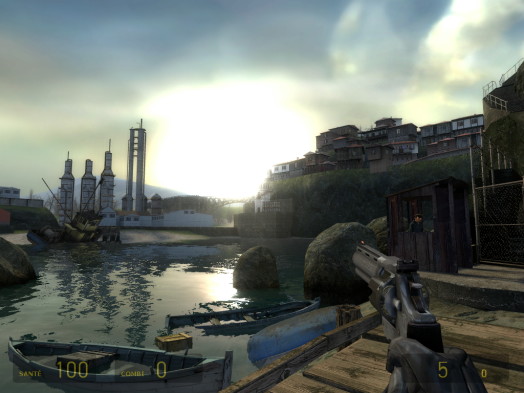
TSRP, or The Specialists Role-Play is a mod of a mod. A team of coders and artists created a modification of the first-person shooter Half-Life, creating an alternate game inspired by, among other influences, The Matrix. Originally the game was a simple deathmatch-type game, the twist of course being able to do impressive stunts and slow down time to kill other players as stylistically as possible for the most points, in locales including a replica of the lobby shootout scene in the original Matrix.


Eventually, though, a sub-community formed. These people were role-players that redefined the way the game was to be played. Instead of running the around the map, doing impossible stunts and killing everything in sight using names such as "l33T aZn SnIpEr", these players created characters with personalities and walked around newly created city-like places conversing with other characters, spontaneously creating story lines while using realistic first and last names. In addition, people created forums to keep track of the events that went on in each server, as well as to talk to the players behind the characters about the game or other topics. Eventually (and keep in mind that almost everyone involved was in their early to mid teens) people learned to code for the game, creating role-play modifications like economies with money, items and property and the all-important TalkArea that only displayed chat messages within certain ranges (narrative "/me" statements, normal talking, shouting, whispering, and phones)--useful not only for realism, but for reducing the inevitable spam of 32 players talking simultaneously. As a major figure in the development and administration of most of the successful TSRP communities, there's much history I'd like to share (especially events in-game and on the forums) but if I get started, I won't stop. As a side note, it's a shame how the Wikipedia article doesn't mention anything about how each community shaped the game and led to the creation of other communities.

But yeah, back to the whole anonymity thing, with the deceptive and harmful behavior. With this, I'm in total agreement. Since people are interacting online using such methods as text in a forum or in-game chat or through actions in a video game, it's very easy to forget that you are dealing with other human beings. The lack of face-to-face interaction makes it easy to ignore the consequences of one's actions.


Therefore, it's real easy to be a dick to others, considering how the people you're pissing off can't retaliate in any real way.


In my experience with TSRP, most of the griefers I had to deal with were DMers, who blatantly ignored the role-play rules and ventured into our servers with the sole purpose of intentionally disrupting the gameplay of others by killing them repeatedly in a Deathmatch-like fashion.

But that's just easy in-game asshole stuff that can be remedied with a quick slap of the banstick. The really interesting problems come from people who have problems. Such people confirm French philosopher Paul Virilio's (some dude in the chapter) opinion that "there is a serious social problem afoot when able-bodied people assume a home-bound existence to conduct their social life online and through media." Yes, I know what the RP in TSRP stands for; does it really mean that it's OK to roleplay everything? I've seen many screenshots and demos of people who have caught other members having cyber sex. The indefensible part is that these weren't in-character relationships that have been developing over a relatively long period of time--it always seemed to be the same set of people whose sole purpose seemed to get together online using random names, find a place on the map where they think no one can hear them, and amaze each other with how fast they can type with one hand. The LOL-worthiest part of it all was how, since I knew everyone pretty well and used administrative software to keep track of peoples' Steam IDs, IP addresses and character names, I noticed that the female character in the cybering sessions was always controlled by a dude and as far as I could tell, the other player had no idea--


--which reminds me some more things about deception. Lying about your gender in-game isn't very hard at all. What I found to be most impressive was this one guy (with whom I later led a community) who created and used over a dozen forum accounts simultaneously, each with a unique personality. Eventually he was outed by someone, and I confirmed his trickery by matching the IP addresses of the posts. He had so many names that in the thread debating his actions, no one knew what to call him. Don't get me wrong, Scar (if you ever read this): you're a great guy and have done a lot for the community, but with this debacle plus your long rap sheet of cybering as both a guy and a girl, there's something not quite right with you (or maybe you are, as Turkle suggests, a person whose self is "multiple, fragmentary and complex").

Oh, man. Looking back, it's hilarious how many people were caught cybering. I think the most controversial cybering-related event involved one of the server owners and one of the other administrators, who he conveniently replaced me with as top admin. Everyone knew what was going on, but considering the powers admins had, no one got close enough to get any proof. All I did was publically ask "Hey, isn't cybering with a minor illegal?" and bam--permabanned, admin stripped. Funniest. Shit. Ever. I'd link to it, but I'm trying to distance myself from anything related to TSRP--including contributing to its Wikipedia article.

Although TSRP was an online community and had the unique symptoms of anonymity-inspired assholishness, it's also almost exactly like real life. Sure, deceptive and harmful behavior may be more common, but that's only because getting caught has no real repercussions; people still do them IRL. As an admin I had all the responsibilities one could expect in an actual business environment, with each day testing my managerial and people skills, as well as my judgment and morals with each problem that arose or decision that had to be made. I also had to deal with incompetent and abusive coworkers, dumbass customers and office politics, including people who sleep their way to the top.

It's funny how a game can be so much like real life. It's probably because to some people, it is.

Wednesday, March 21, 2007

Postmodernism and Popular Culture

S&C tell us that "postmodernism dispels the idea that surface does not contain meaning in itself". Basically, looks matter. Some good proof of that are sororities, specifically how they tend to kick out the fat chicks.

Enlarge? No thanks, I'm good. Try joining "Iota Eta Pi".

I'm not exactly sure why there's such an uproar about that in the first place. Even if sororities weren't private organizations that can choose whoever the hell they want to get drunk with, who are we to kid ourselves that looks don't matter? Last year there were around 11.5 million cosmetic surgeries in the US, and that annual figure is rising, not falling. It's not that we've suddenly become superficial; it's that we're starting to realize we are.

Click to +Enlargenify.

Why? Well, back to the S&C quote: surface contains meaning. People can look on the surfaces of others and extract meaning from that information. You may call it being superficial or even stereotyping, but I call it winning money on national television.

Hooters girl, final answer!

Try it for yourself! What meaning can you this extract from this randomly-generated South Park character?
Yup, totally random.

From the bluetooth headset, we can assume this person is interested in technology. The half-asleep eyes with bags underneath them and the yawn all tell us he's not the type of person who gets much sleep. The shady clothing would make you think he were a high-tech drug dealer were it not for the glasses. Putting it all together, if you were to ask this character how he'd rather spend his time, you can be sure that he's more likely to prefer staying up all night downloading copyrighted material on a stolen Internet connection than personal hygiene such as shaving.

Wednesday, March 7, 2007

The Mass Media and the Public Sphere


Our media mistresses Marita and Lisa bring our attention to Raymond Williams' theory of "television flow, the concept that viewers' experience of television involves an ongoing rhythm that incorporates interruption". They go on to say that that the continuity television creates despite these interruptions "establishes patters of daily experience in our lives" and that "it provides a different phenomenological experience from that of the computer." If I had read this a few months ago, I wouldn't've believed it, but then again that was during a time where most of my "phenomenological experiences" occurred near computers.
Somewhere between then and now I happened to be on the first floor of my dorm when I heard one of the most famous clock-related sounds of all time.
I stumbled upon the first floor's Jack Bauer night. Needless to say, I spent the next hour watching 24 with a bunch of dormmates, eating pizza and sharing theories during the commercial breaks.

Had I just waited a couple of hours and streamed or Torrented an HDTV version of the episode with the commercials cleanly cropped out of it (hypothetically, of course), I would never have had the same experience. There's way more to high-quality shows like 24 than just the content of the episode. You gotta sit around with a group of friends and experience it together, and that's what I have done every week since.

So yeah, do not phone me (or contact me at all!) from 9 to 10 on a Monday night. That line is dedicated to calling the easter-egg numbers they sneak into many of the episodes.

Wednesday, February 28, 2007

Video Games & Narrative

Ah, right up my alley.

Henry Jenkins' article discussing video games and the stories they tell coincides nicely with another article published on Monday that became a subject of discussion over on Slashdot. Jenkins introduces us to the Ludologists and the Narratologists, who are in a conflict over what the focus should be in a game: its mechanics or its storytelling. This conflict makes it seem as if the two are mutually exclusive or that games would be better if they were. I've played many games that are excellent in combining the two, so to me this conflict is a bunch of nonsense.


Jenkins mentions the Half-Life series briefly, and to me this game is a prime example of blending story with gameplay. While some games are obsessed with using cut-scenes and other traditional forms of storytelling (a "feature" one game design lecturer I regularly listen in on despises, telling us that if he wanted to watch a movie, he'd go watch a movie), Half-Life, as Jenkins puts it, is "empty" of those "contemporary narrative activities". While Valve, Half-Life's developer, does not underestimate the importance of a good plotline (see Marc Laidlaw), it also knows that a game is to be fun, and if its 50+ game of the year awards mean anything, they certainly delivered in that department. Half-Life's world isn't spoon-fed to you. It's simply there. However, there are definitely enough clues in the game so that the entire plot of the series can be pieced together, very little of which is directly told to the player.

One of the most astonishing examples of piecing together a storyline, though, is that done in part six of a retrospective dedicated to the Legend of Zelda series.

Although Nintendo has made over a dozen Zelda games (which, since they are more on the role-playing side, rely on traditional storytelling methods), there is little to no explanation as to how each title is connected, much less the order in which each game is placed on a timeline. After carefully scrutinizing every event in each these games, a jaw-dropping split-time theory has emerged that fits seamlessly, relying on the ending of what many people consider to be the best game ever, The Legend of Zelda: Ocarina of Time for the Nintendo 64. The storyline in that game alone made me take a picture of the TV when I finally beat it. Sadly, I don't have that picture anymore, so a video explaining the split timeline theory will have to do.


So uh, yeah. Games can definitely achieve a perfect balance between story and gameplay. The thing about games, though, and the reason I think people have begun to value the plots in games less and less, is that they're not movies or books. Games are interactive, so their storylines must be as well. Forcing plot down a gamer's throat removes that interactivity. Some games have tried to work around this issue by making the plot twist around the player's moral decisions, but often things still feel too linear.

We gamers are smart. Build us a universe and a story, but don't spoil either. If your story is interesting, we will go out of the way to learn more about it. Provided you thought everything through ahead of time and constructed your game correctly, we should be able to figure everything out for ourselves.

Wednesday, February 14, 2007

Spectatorship, Power and Knowledge

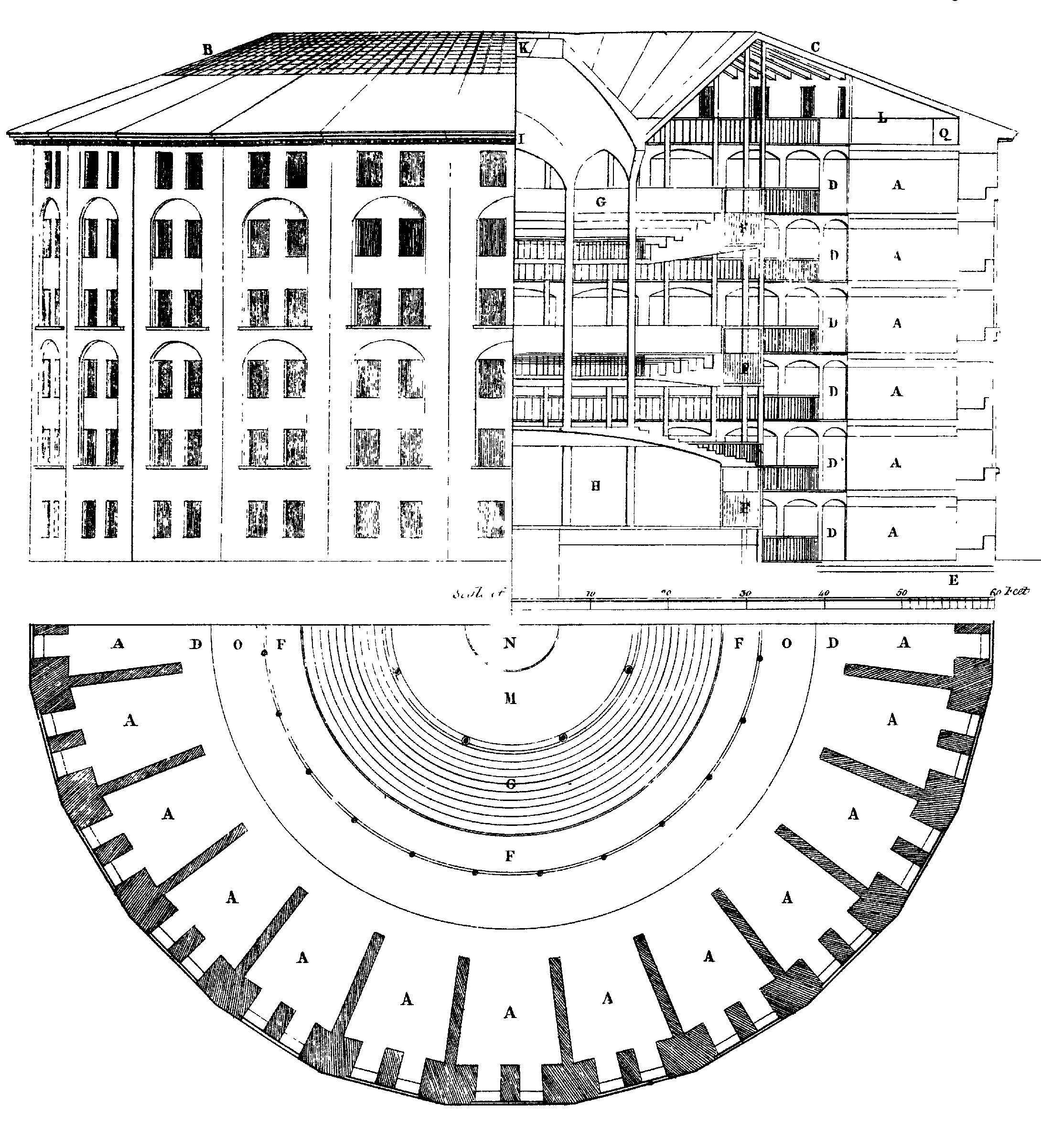
Above is a blueprint for Jeremy Bentham's Panopticon, a concept originally designed to be implemented in prisons. A Panopticon prison operates under the principle that since we behave when the authorities are watching, we will continue to behave so long as we believe we are still being watched. Therefore, a cylindrical prison with a guard tower in the middle will produce the same effect provided that the prisoners are not able to see if there is anyone in the tower to watch them.

The Panopticon principle applies to various other situations as well including, as John points out with Tabatabainejad's taser-induced dramatics over at UCLA, against the authorities themselves now that camera phones are everywhere. The whole world better be on its best behavior now; there's just too great a chance that the instant you lose your cool there will be someone there to catch it and post it on YouTube.


Tabatabainejad gets tabatabatasered

This whole Panopticon thing reminds me of an experiment from a while back that I unfortunately cannot refind: basically, a coffee shop was losing a considerable amount of money because no one paid when they used the self-serve thermos pump thingies despite the sign nearby with a list of prices. Apparently, all the owner had to do was include a pair of eyes to the sign and people were much more likely to pay up for the coffee they were drinking. This concept can also be used when creating "please take one candy" signs for Halloween.


Interestingly enough, the word Panopticon comes from all (pan-) and observe (-opticon) , or all-seeing. Can you think of anyone who sees everything and wants you to be good?

Close, but no blunt; I'm talking about God. Religion is the ultimate Panopticon: there's some invisible dude in the sky that sees everything you do, so you better play nice. Even though the threat of eternal damnation in Hell is there, the real reason to behave is to not feel the disapproving stare of an entity that exists in the exact same way a fiat dollar is worth something.

Whatever happened to behaving for the sake of behaving?

Wednesday, February 7, 2007

Still Image Assignment

Part One: Kruger

I'm not required to blog about this one, but I will anyway if for whatever reason I miss anything when I get called up to “articulate [my] own goals for the image [I] create[d]”. Here’s the finished product—no point in posting the original, not in this case at least:


Basically I took the H-Bomb Image and added to it some jargon in the visual style of Barbara Kruger. In case you are more of a Mac person, the text translates to a series of keyboard shortcuts that are shared by most PC applications. In order, they translate to Select All, Delete, Save, and Quit. This (and, of course, knowledge of Barbara Kruger’s work and the ability to recognize the image as that of an H-bomb, both of which everyone in this course is familiar with) is all that’s necessary to begin interpreting my work. The rest could all hopefully be inferred by the viewer; so take a moment to overanalyze my image real quick like we’ve all had to overanalyze various texts in high school English class because I’m about to spoil it all as soon as I finish typing this sentence right about...now!

First off, I hoped my viewers could make the connection between the PC application commands and what a weapon of mass destruction does—that is, Select All and Delete. Once they’ve figured out that the first two steps apply to both PCs and real life, they would move on to the last two steps. This part’s a little trickier, as they’d have to figure out that once one saves and quits, he can no longer undo.

[This was a concept I chose to not state outright, as I felt that would give too much away. I also considered adding a fifth block of text with the ctrl+z Undo command (or even f12 for Photoshop’s Revert command) crossed out, but I don’t remember seeing any Kruger images with crossed-out text and did not want to deviate from her visual style.]

After figuring this out, they’d begin to ponder the results of creating and detonating weapons of mass destruction. If I were to ctrl+a, del, ctrl+s, and alt+f4 right now, I’d effectively lose the entire blog post I’ve worked on so far as I am typing all of this in Word. Not only that, but no matter how much time I could try and spend retyping everything, the reproduction just wouldn’t be the same—I’d forget some ideas, or at the very least the wording would change slightly. This is true for WMDs as well. You could nuke even an uninhabited area and millions of man-hours later you still would not have reverted it to its original state. This lack of undo also applies to the world as a whole: since the development of nuclear weapons, the planet could be destroyed with the push of a button, and this is an irreversible fact whose consequences we have to deal with for the rest of our lives.

A few more things to think about:

1. The blocks of text are all lined up and numbered. This structure hints at a list of instructions, or in this case, a recipe for disaster.

2. The irony of how something technical like computer jargon could apply to something so human like the potential deaths of millions.

3. The del text serves as a euphemism for wiping out an entire paper just like the military uses euphemisms for many of their violent acts. The sudden change in font size is to point out how small words like del or h-bomb can make a large impact and therefore are bigger than they seem.

Part Two: Punctum

When I was digging through the images looking for something cool to do with them, I could not stop thinking about how the eyebrows of the left-most guy in this image...

...looks almost exactly like the eyebrows of the girl in this image:After laughing uncontrollably for ten minutes, here’s what I came up with:After laughing uncontrollably for another ten minutes, I started figuring out why I liked it so much: the best part, I think, is how the woman went out of her way to make herself up, yet the end result on a real woman is no better than an attempt by a man trying to pass himself off as one.

I’m nowhere near pro at Photoshop, so I’m quite happy with the way it turned out. It’s not even close to being perfect, but I’m at the level that if a moderately intelligent person who has never seen either of the originals before needs more than one good look to be 100% sure the image has been Photoshopped, I’m satisfied.

Since The Americans came out in the 50s, it’s safe to assume that the idea of interracial relationships were taboo when this picture was taken. I just took the controversy one step further by changing the relationship into a homosexual one. People are still uncomfortable about that these days, so I can only imagine how the reaction to my picture would’ve been if it were real.

Part Three: Sign Systems

Imagine the eight million people that subscribe to the MMORPG World of Warcraft. Now picture all the people who have practically lost someone they care about because that person spends all their time playing it. What if these family members all pitched in a few dollars each and hired the world’s best hacker to design a worm that made it seem as if leaflets rained down from the Zeppelins that transport players between continents? What would the leaflets look like?

Here’s the source of my parody:
And here's the leaflet, front:
And back:

The leaflets closely resemble the original, right down to the careless pasting of images, text similar to WordArt, and overall craptasticness. To help convince the addicts to quit, I put part of my argument in terms only they truly understand: item statistics. By presenting them with a piece of Rare (blue-text) armor and a piece of Epic (purple-text, worth more and usually better) armor, the addict will obviously prefer the superior True Love item. However, this “item” is obviously fake and requires the addicts to reestablish a connection with their loved ones, most likely by cancelling their WoW subscriptions.

Indices:
- Photographs are indexical.
- The woman’s frown is indexical proof that the lack of attention from her WoW-addicted loved one makes her sad.
- The reverse is true for the happy family.

Icon
- The images of the two items resemble the items they represent.

Symbol
- The high-level, fully decked-out character is a symbol of an excessive amount of time playing World of Warcraft.

Wednesday, January 31, 2007

Jan 31: Sturken & Cartwright, Images, Power and Politics (1-44)

Let's cut to the chase.

I'm glad I now have a name for something that's been on and off my mind for I don't know how long: The Myth of Photographic Truth. I couldn't agree more with the positions discussed in this portion of the reading. Sure, technically what you see in any photograph did technically happen exactly as you see in the photograph. What some fail to realize, though, is that just like a painting is the creation of its painter, a photo is the creation of its photographer. The bias, in fact, could be even more misleading in a photo than a painting because at least with a painting, we know we are looking at an artist's version of reality; even if the intent is to be as accurate as possible, the accuracy of the painting relies to a great extent on the artist's skill.

Inaccuracies in a picture, though, come solely from the photographer's choices. They come not from what we see, but from how it is shown and what is missing. A photographer most likely would have wandered around the scene several times, looking at various angles, lighting conditions and positions of the subjects before he even bothered to take his first picture. Any pictures he took only exist because he willed them to exist, and this only happened because he found something particularly interesting, satisfying or otherwise appealing in the combination of features in the shot. Consciously or not, this type of thing is bound to happen because of the human element.

So how do we go about fixing this? Should we? Can we? It seems rather impossible to do the latter, particularly because the ones looking for potential bias are more imperfect, biased humans. Would we need some sort of national standard for measuring bias? Ignoring the fact that it would be impossible due to the aforementioned imperfections in our species, where exactly would we draw the line between over-analytical paranoia and cleverly disguised bias? Was this slight overexposure to the film a deliberate attempt at manipulating the reader, or did the reader create his own meaning? Such questions are most likely unanswerable, given how bias is something deeply rooted in our subconscious, especially when we're trying to be as objective as possible.

Until we invent something better, I think we'd all benefit if we admitted that while not perfect, the camera is the closest thing we have to a scientific tool for registering reality. Bias is something we can't control; instead, it controls how and where we aim our cameras, and even whether or not the picture is worth taking at all.

Bias aside, there's still more to reality than what is captured in the lens of a camera.