Henry Jenkins' article discussing video games and the stories they tell coincides nicely with another article published on Monday that became a subject of discussion over on Slashdot. Jenkins introduces us to the Ludologists and the Narratologists, who are in a conflict over what the focus should be in a game: its mechanics or its storytelling. This conflict makes it seem as if the two are mutually exclusive or that games would be better if they were. I've played many games that are excellent in combining the two, so to me this conflict is a bunch of nonsense.
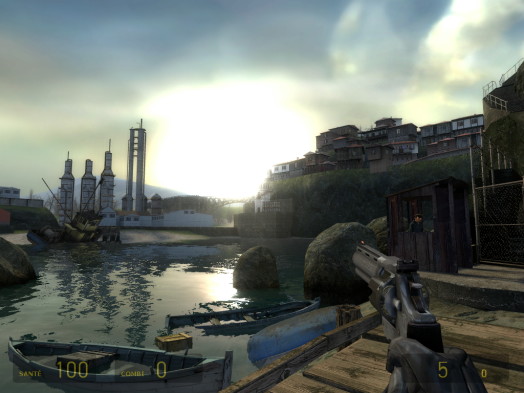
Jenkins mentions the Half-Life series briefly, and to me this game is a prime example of blending story with gameplay. While some games are obsessed with using cut-scenes and other traditional forms of storytelling (a "feature" one game design lecturer I regularly listen in on despises, telling us that if he wanted to watch a movie, he'd go watch a movie), Half-Life, as Jenkins puts it, is "empty" of those "contemporary narrative activities". While Valve, Half-Life's developer, does not underestimate the importance of a good plotline (see Marc Laidlaw), it also knows that a game is to be fun, and if its 50+ game of the year awards mean anything, they certainly delivered in that department. Half-Life's world isn't spoon-fed to you. It's simply there. However, there are definitely enough clues in the game so that the entire plot of the series can be pieced together, very little of which is directly told to the player.
One of the most astonishing examples of piecing together a storyline, though, is that done in part six of a retrospective dedicated to the Legend of Zelda series.

Although Nintendo has made over a dozen Zelda games (which, since they are more on the role-playing side, rely on traditional storytelling methods), there is little to no explanation as to how each title is connected, much less the order in which each game is placed on a timeline. After carefully scrutinizing every event in each these games, a jaw-dropping split-time theory has emerged that fits seamlessly, relying on the ending of what many people consider to be the best game ever, The Legend of Zelda: Ocarina of Time for the Nintendo 64. The storyline in that game alone made me take a picture of the TV when I finally beat it. Sadly, I don't have that picture anymore, so a video explaining the split timeline theory will have to do.
So uh, yeah. Games can definitely achieve a perfect balance between story and gameplay. The thing about games, though, and the reason I think people have begun to value the plots in games less and less, is that they're not movies or books. Games are interactive, so their storylines must be as well. Forcing plot down a gamer's throat removes that interactivity. Some games have tried to work around this issue by making the plot twist around the player's moral decisions, but often things still feel too linear.
We gamers are smart. Build us a universe and a story, but don't spoil either. If your story is interesting, we will go out of the way to learn more about it. Provided you thought everything through ahead of time and constructed your game correctly, we should be able to figure everything out for ourselves.


No comments:
Post a Comment